The Spring Backend Audit Every Soulpreneur Needs

Most entrepreneurs are already dreaming about spring launches and fresh energy right about now. And I love that. There's something about this time of year that makes you want to blow the doors open and start something new.
But here's what I've learned the hard way: if your backend is still carrying the weight of everything you didn't finish in Q1, all that fresh spring energy is going to slam right into the same old chaos. The same cluttered inbox. The same files saved in four different places. The same workflows that sort of work but kind of don't.
So before you make any big plans for Q2, before you build the launch strategy or plan the content calendar or dream up the new offer, I want to talk about something unsexy and wildly powerful.
A backend audit.
I know. Stay with me.
Why Right Now Matters
Here's something about Q1 that nobody really talks about: it's simultaneously the most hopeful and the most chaotic quarter of the year for soulpreneurs.
You came in with intentions in January. February hit and things got real. And now here we are in early March, staring down the last few weeks before Q2 begins, and there's a very good chance your backend is carrying some residue from all of that.
And I don't just mean it's messy. I mean it's quietly costing you energy every single day.
There's a reason you feel low-grade tension when you open your laptop in the morning. A reason you can't quite settle into deep work. A reason your evenings feel like bracing instead of resting.
Your nervous system is picking up on the unfinished loops in your backend. The unsorted files. The inbox that's become a to-do list. The workflows that live in your head instead of somewhere you can actually trust.
The beginning of spring isn't just a calendar event. For many soulpreneurs, it's a natural reset point. And if you do a little intentional cleanup right now, before the season actually shifts, you'll feel the difference in your body before you ever see it in your metrics.
Today we're going to look at three backend bottlenecks to audit right now, the quick wins you can implement this week, and how clean infrastructure is actually what creates spring freedom. Not a vision board. Infrastructure.
Bottleneck #1: Your Email Has Become Your To-Do List
The first bottleneck is the one I hear about most, and it's the one most people have the most complicated feelings about. Email.
I'm not here to tell you to get to inbox zero. That's not what we're doing. What I want you to audit right now is your relationship with your inbox. Specifically, whether your inbox has quietly become your to-do list, your project management system, and your filing cabinet all at once.
Because if it has, here's what that's costing you.
Every time you open your email and see a message that represents an unfinished task, your brain registers an open loop. This is actually a well-documented psychological phenomenon called the Zeigarnik Effect. It's the brain's tendency to fixate on incomplete tasks far more than completed ones.
The short version is this: open loops are cortisol triggers. Your body treats an unfinished email the same way it treats an unfinished conversation, with a low-grade sense of incompletion that just sits there, buzzing. When your inbox is full of them, that buzz runs in the background all day long.
(If you want to understand this concept more deeply, read my post about the Zeigarnik Effect. It's genuinely fascinating and a little bit humbling once you understand what your brain has been doing this whole time.)
The Audit Question
Are there tasks living in your email? Decisions you've been avoiding? Things you've been using your inbox to "remember" for you?
The Quick Win
Spend 20 minutes this week moving every action item out of your inbox and into a dedicated task system. Even if that system is a simple Google Tasks, a spreadsheet, or even a Doc. It doesn't matter what system you use, as long as you'll actually use it.
What matters is this: the inbox is for communication. Not storage. Not task management. Communication.
When you separate these functions, your nervous system can finally stop treating every email like an urgent demand on your attention.
Bottleneck #2: Your Files Are Creating Daily Friction
The second bottleneck is digital files. And this one is sneaky because it doesn't feel urgent until the moment it is. Which is always the exact moment you need something immediately and cannot find it anywhere.
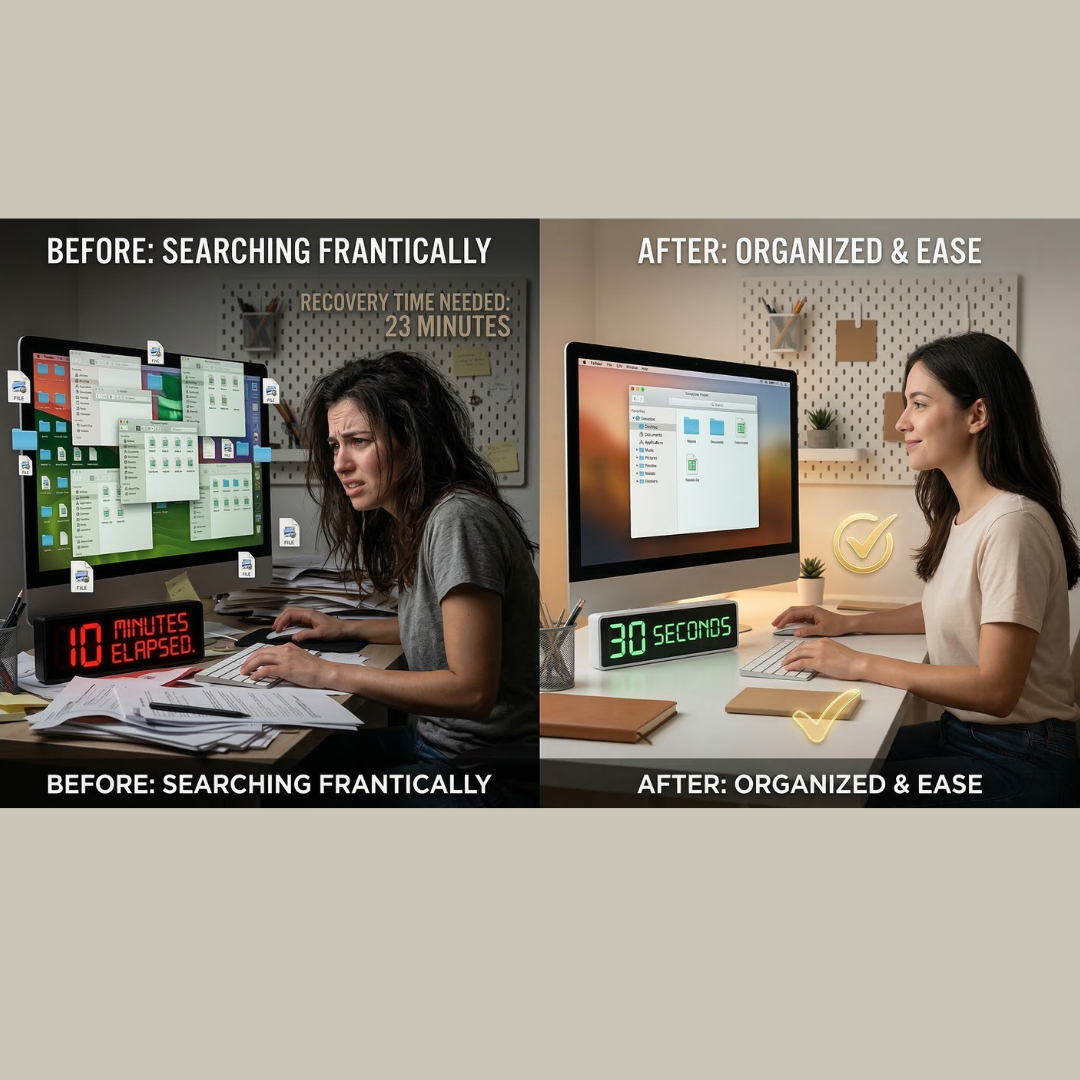
Here's a scenario you probably recognize: You're about to hop on a client call and you need to reference a document you created three weeks ago. You know you saved it. You just can't remember where. Desktop? Downloads? That Google Drive folder? That other Google Drive folder?
You spend ten minutes hunting. By the time you find it, you're flustered and your call is starting late.
Those ten minutes aren't just lost time. They're a nervous system activation. Your body went into mild panic mode. And according to research on digital interruptions, it takes an average of 23 minutes to fully recover cognitively from that kind of disruption.
So you spent ten minutes searching, but you actually lost 33 minutes of focused capacity. That math is not working in your favor.
The Audit Question
Can you find any document in your business in 30 seconds or less? Not three minutes. Not "I know it's in here somewhere." Thirty seconds.
If the answer is no, your file system is creating friction that your nervous system is absorbing every single day.
The Quick Win
Don't try to reorganize everything overnight. That's a recipe for a half-finished project and more chaos.
Instead, pick one folder. Just one. Give it a clear, simple structure this week.
Client files. Templates. Content drafts. Pick the one that costs you the most time when it's disorganized, and start there.
One folder. Thirty seconds to find anything inside it. That's the goal.
When you can reliably find what you need in seconds instead of minutes, you remove dozens of tiny stress spikes from your workday. Your nervous system notices the difference immediately.

Bottleneck #3: Your Workflows Live Only in Your Head
The third bottleneck is the one that hides the best. Workflows. Specifically, the workflows that exist entirely in your head instead of somewhere you can actually use them.
Here's what I mean: Most soulpreneurs have processes they run repeatedly. Client onboarding. Content creation. Sending invoices. Following up on inquiries.
And most of those processes exist entirely as mental muscle memory. You know how to do them. You've done them a hundred times. But they're not written down anywhere. They're not documented. They're not something you could hand off, repeat consistently, or return to after a two-week break without having to reconstruct everything from scratch.
The Audit Question
If you had to step away from your business for two weeks and come back, which processes would feel like starting over? Those are your undocumented workflows, and they're living rent-free in your brain right now.
Why This Matters for Your Nervous System
Here's the piece I want you to really sit with: undocumented workflows create what I call cognitive holding.
Your brain is quietly holding the instructions for every one of those processes alongside everything else it's managing. It's using working memory to store things that should be stored somewhere else. That constant background holding is exhausting in a way that doesn't announce itself. It just shows up as that vague tired feeling that comes even on days when you didn't actually do that much.
The Quick Win
Don't try to document everything. That's overwhelming and you won't finish it.
Instead, pick your single most repeated process. The thing you do most often. Spend 15 minutes writing down the steps or recording your screen as you do it using an app like Loom, Guidde, or Scribe.
Just the steps, in order, in plain language.
That one document will free up more mental space than you expect. Because your brain can finally stop holding those instructions in active memory. They exist somewhere you can trust now.

What a Clean Backend Actually Feels Like
I want to share something one of my clients said after we did this exact work together, because it's stayed with me.
She said: "I thought getting organized was going to feel like doing homework. I was dreading it. But it actually felt like taking off a backpack I didn't know I was wearing."
That's exactly it.
When your email is a communication tool instead of a task dumping ground, when your files have a home and you can find things in seconds, when your most important workflows are documented somewhere outside your brain, your nervous system exhales.
Not metaphorically. Physically.
Your shoulders drop. Your breath gets longer. You stop dreading Monday morning because your backend is holding things for you instead of you holding everything for your backend.
And that's what creates spring freedom. Not the vision. Not the strategy. Not the new offer idea. The infrastructure underneath all of it. The clean, simple, trusted backend that makes everything else possible.
That's what you're building when you do this work.
Your Next Steps
Pick one of the three. Just one.
If your inbox has become a to-do list, start there. If you can't find your files in 30 seconds, start there. If you have a critical workflow living only in your head, start there.
You don't have to overhaul everything before spring arrives. You just have to start one thing, finish it, and feel what it's like to have one less open loop in your body.
Want Support for All Three?
If you want help doing all three bottlenecks and building out the rest of your backend in a way that actually holds, that's exactly what Strategic Blueprint is.
It's my 5-week program for soulpreneurs who are ready to clean up their backend and support their nervous system at the same time. Because those are not two separate things. They never were.
What we cover:
We organize your email system so it's a tool, not a stress trigger. We create file structures that let you find anything in 30 seconds. We document your key workflows so your brain can stop holding them. We build task management you can actually trust. And we integrate nervous system practices so the systems actually stick.
The link is above. No pressure. Just an open door.
Not Ready for Strategic Blueprint Yet?
Start with my free Aligned Action Matrix. It helps you identify which bottleneck is costing you the most energy so you know where to start.
Or take the 5 minute Sacred Systems Audit to determine where to start first.
And if you want to understand why every system you've tried before didn't stick (not because you did anything wrong, but because of something most productivity advice completely misses), read my post about why business systems fail.
Start With One Thing
Go do the one thing. Pick your bottleneck. Spend 20 minutes on it this week. And then come back and tell me in the comments which one you started with. I genuinely want to know.
Because here's the truth: spring energy is coming whether you're ready or not. The question is whether that energy is going to flow freely through a clean backend, or whether it's going to hit the same old bottlenecks and leave you feeling stuck again.
You get to choose.
Stay gold, my friends.