Why Your Brain Won't Let You Rest (The Zeigarnik Effect)
You close your laptop for the day, but your brain doesn't stop working.
You're making dinner, but mentally you're still running through that client project. You're trying to relax with a show, but part of your mind is scanning your to-do list. You lie down to sleep, and suddenly remember seventeen things you forgot to do.
Sound familiar?
This isn't just you being "bad at relaxing" or "too much of a perfectionist." There's actual psychology behind why your brain won't let you rest, even when you desperately need to.
It's called the Zeigarnik Effect, and understanding it changes everything about how you organize your work and protect your peace.
What Is the Zeigarnik Effect?
In the 1920s, a Russian psychologist named Bluma Zeigarnik noticed something interesting. Waiters could remember complex, unpaid orders perfectly. But the moment an order was paid and complete? They forgot it immediately.
She studied this phenomenon and discovered something profound: our brains are wired to hold onto incomplete tasks. Unfinished business creates what psychologists call "cognitive tension"—a low-level mental alert system that keeps the task active in your mind until it's resolved.
Here's what that means for you as an entrepreneur: every open loop in your business is taking up mental energy, whether you're consciously aware of it or not.
That email you need to respond to? Your brain is holding it. That project you started but haven't finished? Mental energy. The conversation you need to have with a client? Background processing. The decision you keep putting off? Active tension.
It's like having twenty browser tabs open in your mind, all running different processes at the same time. No wonder you feel mentally exhausted even when you haven't "done that much" today.
Why This Hits Soulpreneurs Especially Hard
If you're a heart-centered entrepreneur, the Zeigarnik Effect is probably affecting you even more intensely than you realize.
Here's why: You care deeply about your work. You feel personally responsible for every client outcome, every project, every promise you've made. So when something is unfinished, your brain doesn't just note it—it obsesses over it.
You might have just three client projects in progress, but your brain is also holding:
- The email you meant to send yesterday
- The social post you planned but didn't create
- The course outline you started last month
- The conversation you need to have with your team member
- The invoice you forgot to send
- The decision about whether to launch that new offer
- The website update you've been putting off
Each one of these incomplete loops creates cognitive tension. Each one takes up mental bandwidth. Each one makes it harder for your brain to fully rest.
And because you're intuitive and sensitive to energy, you feel this tension in your body. It shows up as that tight feeling in your chest when you think about work. The restlessness when you try to relax. The inability to be fully present with the people you love.
The Hidden Cost of Open Loops
Let me break down what all these open loops are actually costing you:
Mental Energy Drain: Your brain can only hold so much at once. When it's busy tracking incomplete tasks, you have less available for creative thinking, strategic planning, or being present in the moment.
Decision Fatigue: Every time your mind cycles back to an open loop, it's making micro-decisions about whether to act on it now. These tiny decisions add up to real exhaustion.
Sleep Disruption: Your brain processes open loops during sleep. The more unfinished business you're carrying, the harder it is for your mind to truly rest and restore.
Reduced Joy: When part of your attention is always on what's undone, you can't fully enjoy what's happening right now. You're physically present but mentally elsewhere.
This is why you can spend a whole day "working" and feel like you got nothing done. You weren't actually resting, but you also weren't fully focused on completing anything. You were just cycling through open loops.
How to Close the Loops (The Gentle Way)
The traditional productivity advice says: just finish everything. Get it done. Power through.
But that's not realistic, and it's not sustainable. You can't always immediately complete every task. Life doesn't work that way.
So instead, I'm going to show you a gentler approach that works with your brain instead of against it.
Step 1: Get Everything Out of Your Head
Your brain is trying to be helpful by holding onto all these open loops. But it's not actually that good at it. What it needs is to know the information is captured somewhere reliable.
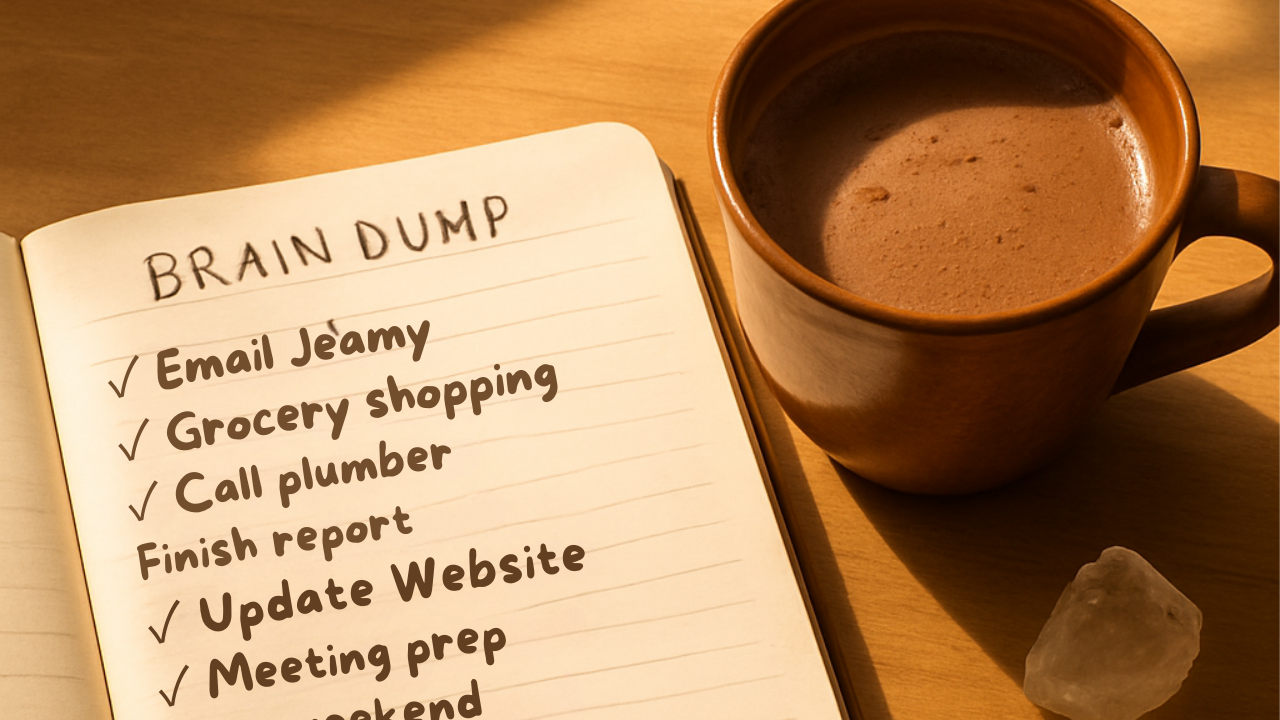
Take fifteen minutes and do a brain dump. Write down every single thing your mind is holding onto—big projects, tiny tasks, decisions you need to make, conversations you need to have. Everything.
Don't organize it yet. Don't prioritize it. Just get it all out of your head and onto paper (or into a document).
What you're doing is telling your brain: "I've got this. You don't need to hold onto it anymore."
Step 2: Identify What Can Actually Close Today
Look at your list and ask: "What could I complete or move forward in the next 30 minutes?"
Not everything. Not half the list. Just a few items that you could actually close.
Maybe it's sending that email. Maybe it's making that decision. Maybe it's scheduling the conversation instead of having it. (Scheduling counts as closing a loop—your brain just needs to know it's handled.)
Complete those few things. Feel the relief as each loop closes.
Step 3: Create "Holding Spaces" for Everything Else
For the tasks you can't complete today, your brain needs to know they have a home. This is where simple systems come in.
Create three categories:
- This Week (things that need attention in the next 7 days)
- This Month (things on your radar but not urgent)
- Someday/Maybe (ideas and projects for later)
Move everything from your brain dump into one of these three spaces. Your brain doesn't need you to do everything right now. It just needs to know where things live and when you'll address them.
Step 4: Do a Weekly Review
Here's the practice that changes everything: Once a week, spend 20 minutes reviewing your three categories.
What got done? (Close those loops—mark them complete.) What needs to move from "This Month" to "This Week"? What can move from "This Week" to "Someday/Maybe" because it's not actually urgent?
This weekly check-in gives your brain the signal it needs: "We have a system. Things aren't falling through the cracks. You can relax now."
What Happens When You Start Closing Loops
When you begin intentionally closing loops and giving everything else a clear home, something shifts.
Your brain stops running that constant background scan. That tight feeling in your chest loosens. You can actually be present when you're not working.
One of my clients described it like this: "It's like someone turned down the volume on the constant noise in my head. I didn't even realize how loud it was until it got quiet."
You'll notice you can focus more deeply when you're working. You'll sleep better. You'll be more present with your family. You'll access your creativity more easily because your mind has space to wander and play.
This is what happens when you work with your brain's natural wiring instead of fighting against it.
Your Next Step
If you're feeling the weight of too many open loops right now, start with just one simple action.
Set a timer for 15 minutes and do a brain dump. Get everything out of your head. Every task, every decision, every incomplete thing your brain is holding.
Then pick just one thing from that list—the smallest, easiest thing—and close that loop today.
Notice how it feels in your body when you mark it complete. That little release of tension? That's the Zeigarnik Effect losing its grip.
Want Help Building This System?
If you're carrying dozens (or hundreds) of open loops and need support creating a system that actually works for your brain, I created the Strategic Blueprint Program specifically for this.
In five weeks, we build a supportive framework for your business backend that helps you close loops, organize your work, and finally give your nervous system permission to rest.
You can also grab my free Aligned Action Matrix to start identifying where your open loops are creating the most tension.
Give Your Brain Permission to Rest
Your brain isn't broken for holding onto unfinished tasks. It's actually trying to help you by making sure nothing important gets forgotten.
But you don't have to carry everything in your head anymore. You can create simple systems that hold the information for you, so your brain can finally exhale.
Drop a comment and tell me: How many open loops do you think you're carrying right now? 5? 20? 50? I'm genuinely curious where you're at.
Here's to closing loops and reclaiming your peace.
Stay gold, my friends. 💫