Why Every Business System You've Tried Has Failed (And What Actually Works)
You've tried Notion. You've tried Asana. You've tried bullet journals, time blocking, the Pomodoro method, Monday.com, ClickUp. Maybe you've even hired a VA to manage it all for you.
And for about two weeks? It works. You feel organized. You feel in control. You think "THIS is the system that's finally going to stick."
And then it doesn't.
You abandon it. Or it becomes one more thing cluttering your life instead of simplifying it.
And everyone tells you the same thing: "You just haven't found the right system yet. Keep looking."
That's complete nonsense.
The reason every business system you've tried has failed isn't because you haven't found the right one. It's because you're trying to fix an external problem with an external solution when the real issue is internal.
Let me explain.
The Pattern You're Stuck In
Here's what happens, and I bet this sounds painfully familiar:
You discover a new productivity system. Maybe you see it on YouTube, maybe a business friend raves about it, maybe it's the hot new app everyone's talking about.
You get excited. You set it up. You customize it. You make it perfect.
Week 1: You're using it religiously. Everything's going into the system. You're checking it daily. You feel SO organized.
Week 2: Still going strong. A few tasks slip through, but you're mostly on track.
Week 3: You miss a day or two. Life gets busy. You tell yourself you'll catch up this weekend.
Week 4: You're back to your old habits. The system is sitting there, partially filled out, mocking you. You feel like a failure.
And here's what you probably tell yourself: "I'm just not disciplined enough." Or "This system doesn't fit my brain." Or "I need to find something simpler."
So you go looking for the NEXT system. And the cycle repeats.
But here's what nobody's telling you: The problem isn't the system. And it's not you.
It's that you're only addressing half of the problem.

Why Traditional Business Systems Actually Fail
Most productivity systems focus entirely on the external: your tasks, your files, your inbox, your calendar.
And that makes sense, right? Those are the things that are chaotic. Those are the things you can see and touch and organize.
But here's what they're missing: Your external chaos is a symptom, not the cause.
Let me give you an example.
You set up a beautiful task management system. Color-coded. Prioritized. Everything has a due date.
But every time you open it, your chest tightens. Your breathing gets shallow. You feel overwhelmed before you even start.
So you close it. You avoid it. You go scroll Instagram or YouTube instead.
And you think that's a willpower problem. But it's not.
It's a nervous system problem.
Your body is responding to that task list like it's a threat. And when your nervous system is activated (when you're in fight, flight, freeze, or fawn mode), you literally cannot use organizational systems effectively.
Your brain isn't in a state where it can prioritize, plan, or execute. It's in a state where it just wants to survive.
And here's the kicker: the more chaotic your backend is, the more your nervous system stays activated. Which means the less you're able to use the systems that would help you.
You're stuck in a loop.
Disorganized backend → activated nervous system → can't use systems → backend stays disorganized → nervous system stays activated.
This is why you can't "just find the right system." Because no external system can override an activated nervous system.

The Two-Part Problem Nobody Talks About
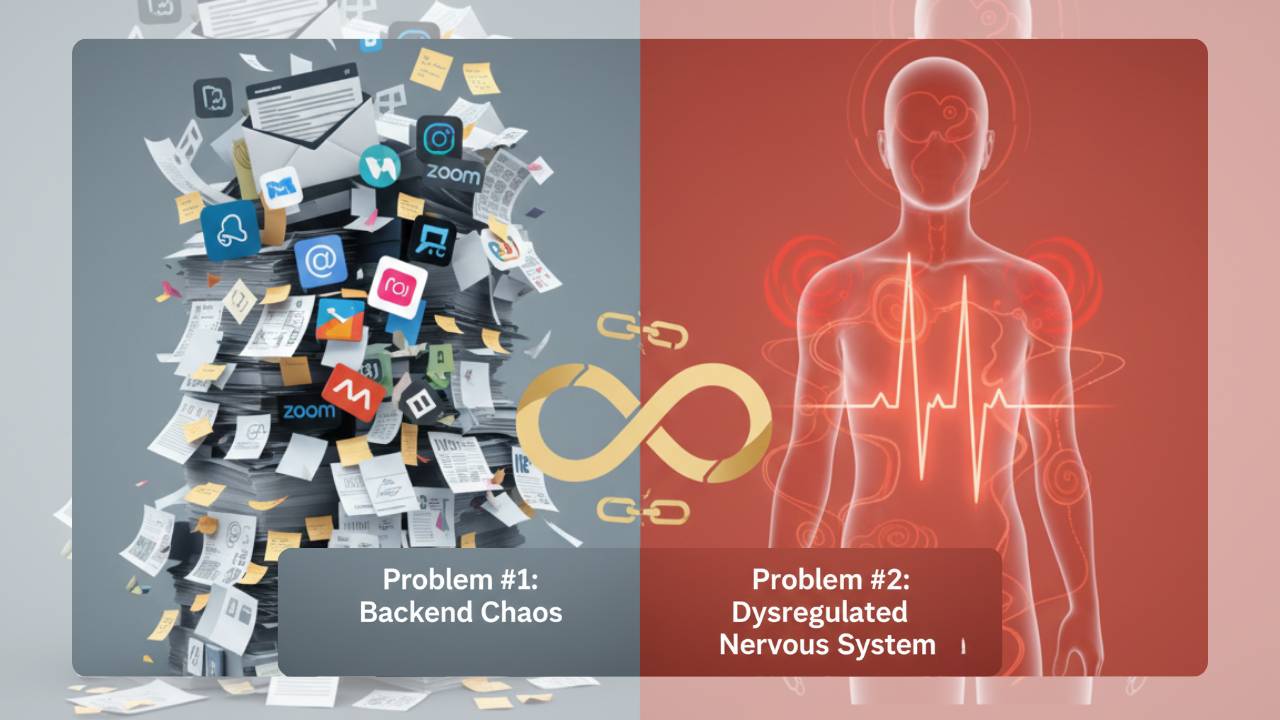
So here's what you actually need to understand: You have two problems, not one.
Problem #1: Your Backend Is Chaos
Your files are scattered. Your inbox is overwhelming. Your tasks live in your head, on sticky notes, in 17 different apps. You don't have clear systems for how information flows through your business.
This is the external problem. This is what you see. This is what most productivity systems try to fix.
Problem #2: Your Nervous System Is Dysregulated
Every time you look at your chaotic backend, your body responds with stress. Your heart rate increases. Your breathing gets shallow. Your cortisol spikes.
And when you're in that state, you can't think clearly. You can't make good decisions. You can't organize effectively.
This is the internal problem. This is what you feel. This is what most productivity systems completely ignore.
And here's the crucial part: You can't fix one without addressing the other.
If you organize your backend but your nervous system is still dysregulated? You won't maintain the systems. You'll fall back into chaos because your body is still in survival mode.
If you regulate your nervous system but your backend is still chaos? Every time you sit down to work, you'll get re-triggered. The external chaos will bring you right back to internal dysregulation.
You need both.
You need to organize your backend AND give your nervous system tools to stay regulated while you're doing it.
This is why every system you've tried has failed. Because they only gave you half the solution.
What Actually Works: The Two-Part Solution
Let me walk you through what actually works.
When you address both the backend systems and the nervous system regulation simultaneously, systems actually stick.
Here's what that looks like in practice:
Part 1: Backend Systems (External Structure)
This is the part you're probably familiar with, but we do it differently.
We're not creating complex, perfect systems. We're creating minimum viable systems. Just enough structure to reduce chaos without becoming one more thing you have to maintain.
The essentials:
- One clear file organization system where everything has a home
- Inbox management that reduces triggers (not just "inbox zero" for the sake of it)
- Task management you can actually see and use (visual, simple, not overwhelming)
- Clear workflows for recurring tasks so you're not reinventing the wheel every time
Notice what's NOT on that list: fancy automations, color-coding everything, tracking every metric, building elaborate dashboards.
We start simple. We start with what actually reduces your nervous system activation.
Because here's the truth: The goal isn't to have perfect systems. The goal is to have systems that let your nervous system relax.
Part 2: Nervous System Regulation (Internal Capacity)
This is the part most people completely skip. And it's why their systems fail.
You need to learn to recognize when your nervous system is activated. Because when you're activated, you can't organize effectively.
The signs you're activated:
- Chest tightness when you look at your task list
- Shallow breathing when you open your inbox
- Impulse to close the app and do literally anything else
- Decision paralysis (can't pick what to do first)
- Scrolling instead of working
When you notice those signs, you don't just "push through." That's how you burn out. And we don't want that. You have beautiful offerings to bring to the world.
Instead, you regulate first, then organize.
Simple regulation tools:
Box breathing before you open your task management system: 4 counts in, 4 hold, 4 out, 4 hold. This signals to your nervous system that you're safe.
Physical grounding when you feel overwhelmed: Feet on floor, notice 5 things you can see. This brings you back into your body and out of fight-or-flight.
Micro-breaks built into your organizing sessions: Regulate every 20 minutes. Don't wait until you're completely dysregulated.
Permission to stop when you hit your capacity: Organizing while activated makes things worse, not better.
The goal is to stay in what's called your "window of tolerance." That's the zone where you can actually think clearly and make good decisions.
When you combine clean backend systems with nervous system regulation? Systems stick.
Because your body isn't fighting them anymore.

Why This Changes Everything
Here's what happens when you address both simultaneously:
You organize your inbox. But before you start, you do 2 minutes of box breathing or just take a few deep breaths. You stay regulated while you work. You take breaks when you need them. The task doesn't feel overwhelming because your nervous system isn't activated the whole time.
Result: Your inbox stays organized because you didn't traumatize yourself while organizing it.
You set up your task management system. But you keep it simple. Just enough structure to reduce chaos. You don't try to make it perfect. You give yourself permission to adjust it as you go.
Result: You actually use the system because it's not overwhelming to look at.
You build your workflows. But you build in nervous system breaks. You recognize when you're getting activated and you stop before you hit burnout.
Result: You maintain the workflows because they support your capacity instead of exceeding it.
This is what "systems that actually work" looks like.
Not perfect systems. Not complex systems.
Systems that honor both your business backend and your nervous system.
And when you have both? You stop abandoning systems. You stop feeling like you're failing. You stop searching for the "right" system.
Because you finally have what you actually needed all along: a two-part solution to a two-part problem.
My Own Journey With This
I spent years trying every system, platform, and new tool out there. I'd set them up perfectly, use them for a few weeks, then abandon them. And I'm a very disciplined person with strong willpower, but I abandoned them every single time. And I'd beat myself up, thinking I was the problem.
There was nobody teaching this back then. Nobody connecting the dots between business chaos and nervous system dysregulation.
It wasn't until I understood that my body was responding to digital chaos like it was actual danger that everything changed. When I looked at what I could remove or simplify, when I got clear on my North Star, when I started addressing both simultaneously (organizing my backend and regulating my nervous system), systems finally stuck.
My business transformed. I stopped feeling like I was drowning. I could actually think clearly. I could check things off my task list at the end of each day. I could make aligned decisions. I could scale.
And that's what I want for you.
Because you deserve systems that actually work. Not because you "found the right one." But because you finally addressed the real problem.
What This Looks Like in Practice
If you're sitting here thinking "This is exactly what I've been missing," you're right.
This is exactly what we do in Strategic Blueprint.
Strategic Blueprint is my 5-week program where we build both your backend systems and your nervous system capacity to maintain those systems.
Most programs give you templates and tell you "good luck." We do it differently.
Here's what we cover:
Your North Star - Get clear on what actually matters so your systems serve your vision (not just organize your chaos)
Inbox Zen - Build an email system that reduces nervous system activation (not just "inbox zero")
Digital Declutter - Organize your files so you can find things without your heart racing
Task Management - Create a system you'll actually use (because it's built around your capacity)
Automation & Delegation - finding how you can incorporate these in your business
Nervous System Integration - Learn to recognize activation and regulate so your systems stick
Plus you get weekly live coaching calls and a 1:1 Strategic Scale Session after you complete the 5 weeks. We set up your backend first, then we scale and maintain.
But here's what makes it different: We address both the external systems and the internal nervous system regulation from day one.
Because I learned the hard way (just like you) that you can't fix one without the other.
Not Ready for Strategic Blueprint Yet?
Start with my free Aligned Action Matrix. It helps you identify what's causing the most overwhelm and what to tackle first.
Or grab the Inbox Zen Guide to start creating a calmer relationship with email.
You're Not the Problem
If you've been beating yourself up because "nothing sticks," stop.
It's not that you're not disciplined enough.
It's not that you haven't found the right system yet.
It's that you've been trying to solve a two-part problem with a one-part solution.
And now you know better.
External systems + internal regulation = systems that actually stick.
That's what works.
Drop a comment and tell me: Which system have you abandoned most recently? And did you recognize the nervous system piece while reading this? I'm genuinely curious where you've been stuck.
Stay gold, my friends.💫