Why Entrepreneurs Feel Overwhelmed (And How to Actually Fix It)

You wake up already thinking about your to-do list. By 10 AM, you've answered seventeen emails, put out two fires, and added five more tasks to an already impossible list. By 2 PM, you're exhausted but can't point to a single meaningful thing you've accomplished.
Sound familiar?
Entrepreneur overwhelm isn't just about having too much to do. It's about the constant weight of responsibility, the never-ending decisions, and the feeling that no matter how hard you work, you're always behind.
Most advice about overwhelm focuses on time management or productivity hacks. But here's what those articles miss: entrepreneur overwhelm isn't just a schedule problem. It's a nervous system problem combined with a backend systems problem.
And until you address both pieces, you'll keep spinning your wheels.
What Entrepreneur Overwhelm Really Looks Like
Let me paint a picture of what I see with the soulpreneurs I work with:
You have a business you're passionate about. You started it because you wanted freedom, flexibility, and the ability to serve people in meaningful ways. But somewhere along the line, your business started running you instead of the other way around.
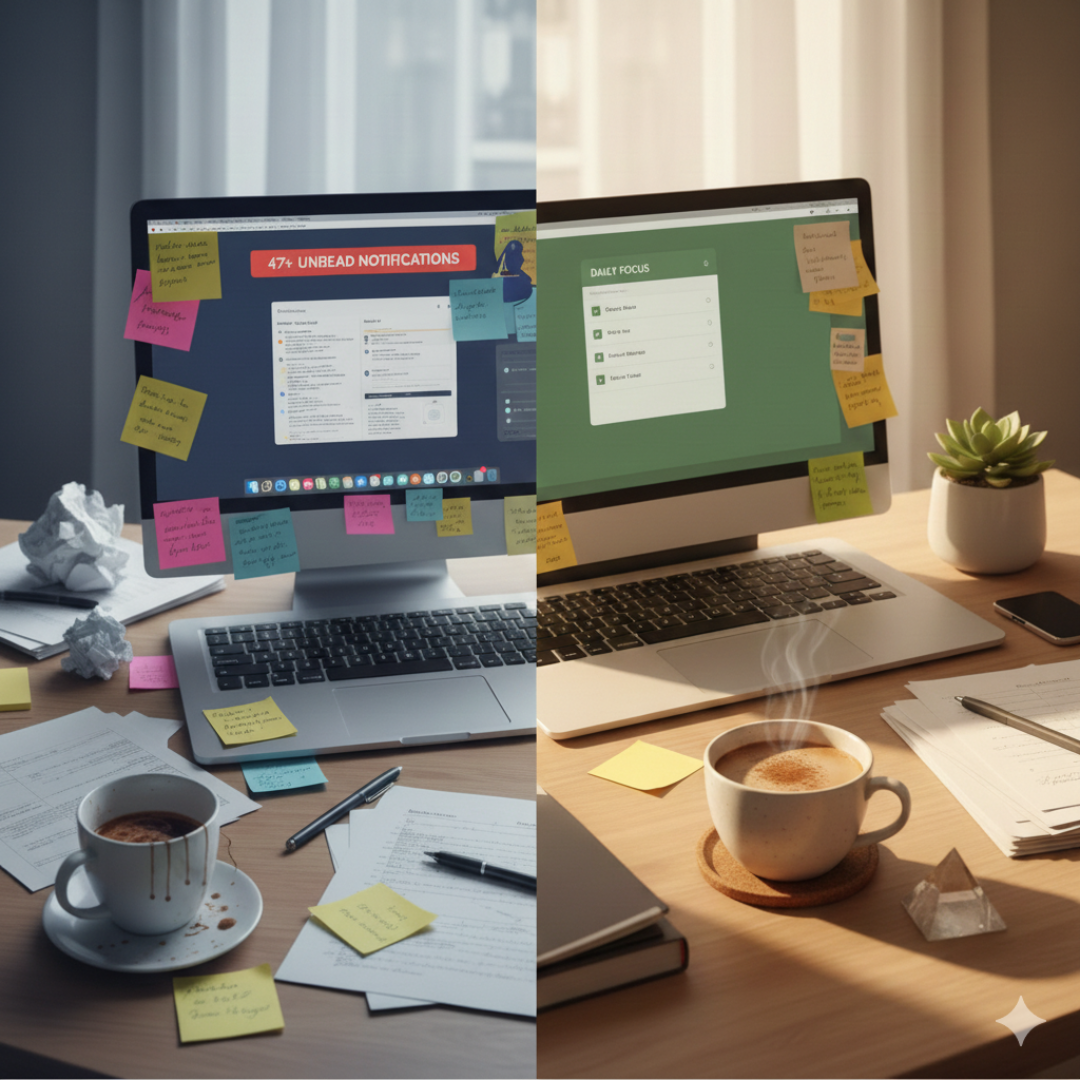
Your inbox has thousands of unread emails. Your desktop is covered in files you meant to organize "later." You have seventeen browser tabs open at all times because you're afraid of losing something important. Your task list lives partly in your head, partly in a notebook, and partly scattered across random apps.
Every morning, you sit down to work and immediately feel that knot in your chest. Your brain starts scanning: What's urgent? What did I forget? What's going to fall through the cracks today?
You spend your days reacting instead of creating. You're always busy but rarely productive. And you end each day feeling guilty about what you didn't get done.
This is entrepreneur overwhelm. And it's not because you're doing something wrong.
Why Traditional Productivity Advice Doesn't Work
Most articles about overwhelm will tell you to:
- Make a to-do list
- Prioritize your tasks
- Delegate or outsource
- Take breaks
- Learn to say no
And look, that's not bad advice. I actually give that same advice. But it's incomplete.
Because here's what happens when you try to implement those strategies while your nervous system is activated and your backend is chaos:
You make a to-do list, but your brain is still holding onto everything because you don't trust the system. You try to prioritize, but everything feels urgent when your inbox is exploding and your files are scattered. You want to delegate, but you can't even find the documents you need to hand off. You try to take breaks, but your mind won't stop spinning.
The problem isn't your discipline. The problem is that you're trying to organize your work while your entire digital ecosystem is triggering your nervous system into constant alert mode.

The Two Hidden Causes of Entrepreneur Overwhelm
Let me explain what's really happening when you feel overwhelmed.
Cause #1: Your Nervous System Is Constantly Activated
Your nervous system has one job: keep you safe. When it perceives threat, it activates your fight, flight, or freeze response.
Now, you're not actually in danger. But your nervous system doesn't know the difference between a physical threat and the psychological stress of running a business.
Every time you open your chaotic inbox, your nervous system registers: "Too much. Can't process all this." Every time you can't find a file you need, your system activates: "Something's wrong. We're not in control." Every time you see that growing to-do list, your body tenses: "We'll never get through this."
This isn't happening consciously. It's happening in your body. And it's draining your energy before you even start working.
You end the day exhausted not because you accomplished so much, but because your nervous system has been in a constant state of low-level alert.
Cause #2: Your Backend Systems Are Creating Cognitive Overload
Here's the other piece most people miss: your digital backend is overwhelming your brain's processing capacity.
Your brain is an incredible pattern-recognition machine. But it can only hold so much at once. When your business backend is disorganized, your brain goes into what I call "background scanning mode."
Part of your mental energy is always trying to:
- Remember where things are
- Track what needs attention
- Hold open loops that aren't captured anywhere
- Make sense of visual clutter on your screen
This is called cognitive load, and it's exhausting.
Think about it this way: imagine walking into a room where every drawer is open, papers are scattered everywhere, and there's constant background noise. Your brain would immediately start trying to process and organize all that chaos.
That's what's happening every time you open your computer. Your desktop clutter, your overflowing inbox, your scattered files—they're all creating cognitive load that drains your energy and makes everything harder.
The Connection Between External Chaos and Internal Overwhelm
Here's what most productivity experts don't understand: your external environment and your internal state are connected.
When your digital space is chaotic, your nervous system stays activated. When your nervous system is activated, you can't think as clearly, which makes it harder to organize your space. It's a cycle.
You can't sustainably organize your external systems when your nervous system is in overwhelm. And you can't calm your nervous system when your external systems are triggering constant stress responses.
You need to address both at the same time.
How to Actually Reduce Entrepreneur Overwhelm
Let me give you a framework that addresses both the nervous system piece and the systems piece.
Step 1: Create One Calm Space
You don't need to overhaul your entire business overnight. That would just create more overwhelm.
Instead, choose one digital space (your desktop, your main email folder, or your primary work folder) and make it completely clean.
Move everything into one folder called "To Sort Later." Don't organize it yet. Just get it out of sight.
Why this works: You're giving your nervous system a visual signal of calm. When you open your computer to a clean desktop, your brain gets to exhale. That one moment of relief creates enough space for you to think more clearly.
Step 2: Close Your Open Loops
Your brain is holding onto every unfinished task, unmade decision, and incomplete project. These are called "open loops," and they're taking up massive amounts of mental energy.
Do a brain dump. Write down everything your mind is trying to hold onto. Every task, every decision, every "I need to remember to..." thought. Get it all out of your head and onto paper.
Then, identify what you can actually close today. Not everything. Just a few things.
Maybe it's sending that email you've been putting off. Maybe it's making a decision you've been avoiding. Maybe it's scheduling a conversation instead of holding it in your head as something you "need to do."
Close just a few loops. Feel the relief as each one completes.
Why this works: When you close a loop, your brain gets the signal that it can stop holding onto it. This frees up mental energy and reduces that constant background anxiety.
Step 3: Create Simple Holding Spaces
For everything you can't close immediately, your brain needs to know it has a home.
Create three simple categories:
- This Week (needs attention in the next 7 days)
- This Month (on your radar but not urgent)
- Someday/Maybe (ideas for later)
Move everything from your brain dump into one of these three spaces.
Your brain doesn't need you to do everything right now. It just needs to know things aren't falling through the cracks.
Why this works: When your brain knows where things live and when you'll address them, it can stop the constant scanning. You're creating a simple system that supports your nervous system.
Step 4: Implement Inbox Zen
Your inbox is probably one of your biggest overwhelm triggers. And I'm not going to tell you to achieve "inbox zero." That's not realistic or sustainable.
Instead, create inbox zen, a calm relationship with email where you're in control instead of constantly reactive. My free Inbox Zen Guide walks you through this process.
Here's how:
- Batch your email. Check it 2-3 times per day instead of constantly. Your nervous system needs protected time where it's not on alert.
- Archive everything older than 90 days. If you haven't dealt with it in three months, you're not going to. It's still searchable if you need it.
- Create three simple folders: Action Needed, Waiting On Response, Reference. Sort what's left into these categories.
Why this works: Email triggers your nervous system because it's unpredictable and constant. When you batch it and organize it, you take back control. Your nervous system can relax because it knows there's a plan.
Step 5: Do a Weekly Reset
Once a week, spend 20 minutes reviewing your systems.
What got done? (Close those loops, mark them complete.) What needs to move from "This Month" to "This Week"? What can move from urgent to later because it's not actually critical?
This weekly check-in is what makes everything sustainable. It's how you prevent the overwhelm from building back up.
Why this works: Your brain needs regular reassurance that the system is working. This weekly practice proves that things aren't falling through the cracks, which allows your nervous system to truly rest.
Why This Approach Is Different
Most overwhelm advice treats it as purely a time management issue. Do more. Be more productive. Work harder.
But entrepreneur overwhelm isn't about working harder. It's about working in a way that supports your nervous system instead of constantly activating it.
When you address both the external systems (your digital backend) and the internal state (your nervous system), something shifts.
You stop feeling like you're drowning. You start feeling like you're in control. You can actually focus on the work that matters instead of constantly putting out fires.
And here's the beautiful part: when your nervous system feels safe, your creativity comes back. Your strategic thinking improves. You make better decisions. You have energy for the vision that called you into entrepreneurship in the first place.
A Real Transformation
I had a client, a heart-centered coach, who came to me completely overwhelmed. She was working 60-hour weeks but barely making progress. She couldn't focus. She felt scattered all the time. She was seriously considering quitting the business she'd worked so hard to build.
When we looked at her backend, we found:
- 4,000+ unread emails creating constant anxiety
- Files scattered across desktop, downloads, and random folders
- Tasks living partly in her head, partly in three different apps
- No system for tracking client work or following up
We spent five weeks implementing the framework I just shared with you. We cleaned up her digital backend. We created simple systems that worked with her brain instead of against it. We addressed both the external chaos and the nervous system piece.
Three months later, she messaged me: "I feel like a different person. I'm working 30 hours a week and getting more done than I did in 60. I actually have energy at the end of the day. And I'm excited about my business again."
That's what happens when you address the real causes of overwhelm.
Your Next Step
If you're feeling overwhelmed right now, start with just one thing:
Do a brain dump. Get everything out of your head. Then pick one loop to close today. Just one.
Notice how it feels when you mark something complete. That relief you feel? That's your nervous system starting to trust that you have this handled.
Ready for More Support?
If you're carrying dozens of open loops and your backend is creating constant overwhelm, I created the Strategic Blueprint Program specifically for this.
In five weeks, we build a supportive framework for both your business backend and your internal state. We organize your inbox, your files, your tasks, and your workflows. But more importantly, we address the nervous system piece that keeps you stuck in overwhelm.
This is the only program I know of that addresses both your business systems AND your internal state simultaneously. Because you can't sustainably organize one without the other.
You can also start with my free Aligned Action Matrix to identify where your overwhelm is coming from and what to address first.
You Don't Have to Stay Overwhelmed
Entrepreneur overwhelm isn't a character flaw. It's not a sign that you're doing something wrong.
It's a signal that your current systems aren't supporting your nervous system. And once you understand that, you can actually fix it.
You didn't start your business to feel this way. You started it for freedom, for meaning, for the ability to serve from your gifts.
That vision is still possible. You just need systems that support it instead of sabotaging it.
Drop a comment and tell me: What's the biggest source of overwhelm in your business right now? Your inbox? Your task list? Your scattered files? I read every comment and I'm genuinely curious where you're struggling most.
Here's to less overwhelm and more spaciousness.
Stay gold, my friends.💫