No 2026 Goals Yet? GOOD. (The Anti-Resolution Revolution)
It's February, and I need to tell you something you probably don't expect to hear from a productivity strategist:
If you haven't set your 2026 goals yet, I'm relieved. Actually relieved.
Not because I don't believe in having direction for your business. But because I've watched this same cycle play out every single year with brilliant, capable entrepreneurs who end up feeling like failures by mid-February.
They set ambitious goals on January 1st. They're full of energy and optimism. They're finally going to get organized, launch that program, show up consistently, clean up their backend.
And then it falls apart. Again.
Not because they lack discipline. Not because they're lazy. But because the entire resolution framework is fundamentally broken.
So if you're reading this in February feeling behind, feeling guilty, wondering why you can't seem to make goals stick, this is for you.
The Truth About January 1st (That Nobody Talks About)
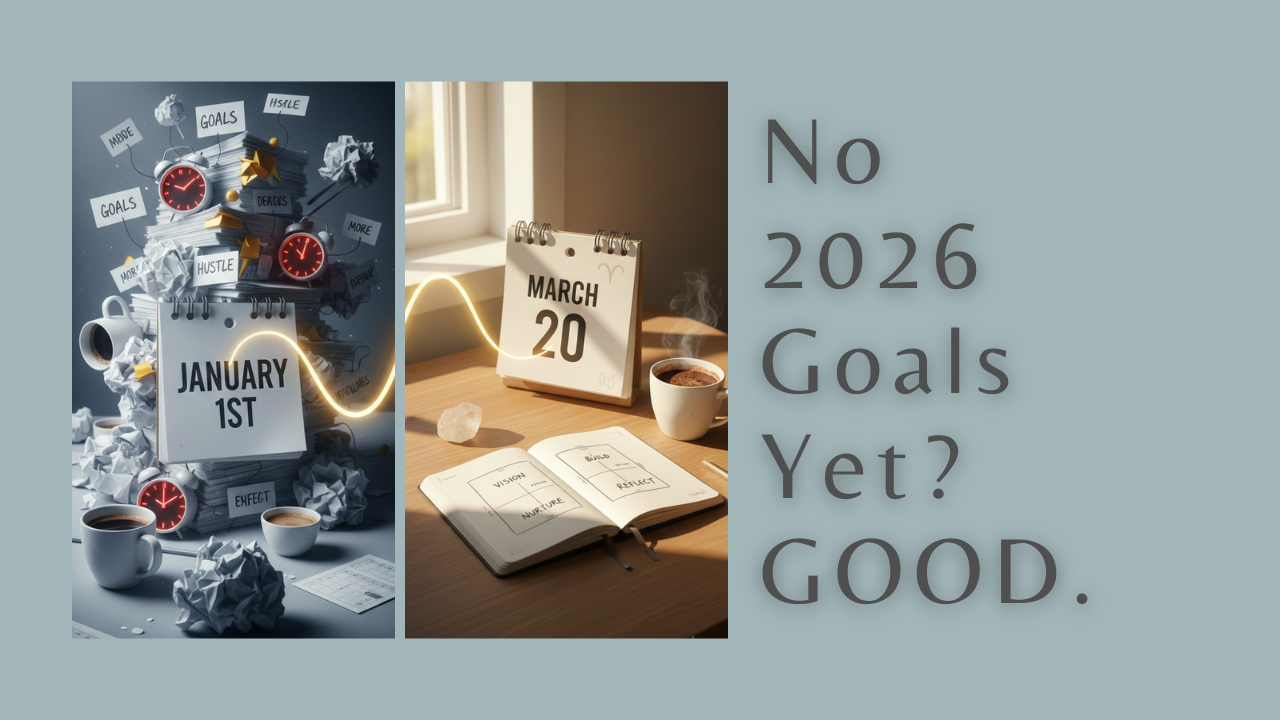
Here's something that might shift your entire perspective: January 1st is an arbitrary date on a calendar created by people who didn't understand natural rhythms or seasonal cycles.
The astrological new year? That's Aries season, starting March 20th. That's the actual energetic reset point.
January energy is for rest. Reflection. Going inward. It's the dead of winter in the Northern Hemisphere. Your body is literally wired to slow down, not ramp up into massive goal-setting mode.
But resolution culture tells you to ignore all of that biology. Push harder. Start strong. Have it all figured out by January 1st.
Then when your nervous system (which is designed to slow down in winter) can't sustain that artificial energy burst, you blame yourself. You think you lack willpower. You think everyone else has it together and you're the only one struggling.
But what if the entire system is designed to make you fail?
Not maliciously. But because it fundamentally misunderstands how human beings actually work.
Why Your Goals Keep Failing (It's Not What You Think)
Let me walk you through what really happens when you set goals without the right foundation.
You start January with excitement. You have your list. This year, you're going to finally get organized. Create consistent content. Launch that program. Clean up your backend. Show up on social media daily.
For about a week—maybe two if you're really motivated—you do it. You're on fire. You're making it happen.
And then it falls apart.
Here's what's actually going on: Your goals require a certain amount of nervous system capacity. They require mental bandwidth, decision-making energy, and creative thinking.
But if your backend is chaos (overflowing inbox, scattered files, tasks living partly in your head and partly across three different apps), your nervous system is using all its capacity just managing that overwhelm.
It's like trying to run a marathon while carrying a hundred-pound backpack. The problem isn't your running ability. The problem is the weight you're already carrying.
So you set these beautiful goals to create more content, launch a program, grow your list. But your nervous system looks at your chaotic backend and essentially says: "Nope. This isn't safe. We can't handle more right now."
You think you're procrastinating. You think you're self-sabotaging.
But what's actually happening is your body is protecting you from taking on more when your current foundation can't support it. No amount of motivation or willpower is going to override that biological response.

The Resolution Culture Lie
Here's how traditional resolution culture tells you to create change:
On January 1st, set big ambitious goals. Create detailed action plans. Commit to massive change across multiple areas. Do it all at once. Sustain it through sheer willpower and discipline.
And when you inevitably can't keep up? You're told it's because you didn't want it badly enough. Weren't disciplined enough. Didn't plan well enough. Lacked commitment.
But here's what the research on behavior change actually shows: Willpower is a limited resource. It depletes throughout the day. And trying to change everything at once is the fastest way to change nothing at all.
Resolution culture is built on a myth. It says you can force transformation through motivation and discipline alone. But motivation is temporary. It comes and goes. Discipline is exhausting to maintain. And neither of them address the actual barriers preventing change.
I see this pattern constantly with clients who come to me in February or March feeling defeated. They set goals in January with the best intentions. They didn't follow through. Again. And they're starting to believe something is fundamentally wrong with them.
But when we look at their business backend, we always find the same thing:
Thousands of unread emails creating constant low-level anxiety. Files scattered across desktop, downloads, and random folders with no organizational system. Tasks living partly in their head, partly in multiple apps, partly on sticky notes. No clear system for tracking client work, following up, or managing day-to-day operations.
And I tell them the same thing every time: "You didn't fail because you lack discipline. You failed because you tried to build a second story on a house with no foundation."
The problem isn't your goals. The problem is you don't have the infrastructure to support them.

The Shift: Infrastructure Over Inspiration
Here's the belief shift that changes everything:
Stop setting goals. Start building infrastructure.
Goals are about what you want to achieve. Infrastructure is about creating the conditions that make achievement inevitable.
Let me show you the difference with a concrete example:
Goal approach: "I'm going to post consistently on social media three times per week."
Infrastructure approach: Build a simple content planning system. Create a file organization structure so you can actually find your content ideas when you need them. Set up an inbox system so you're not constantly reactive. Establish time blocks that protect your creative energy.
See how different that is?
The goal focuses on the outcome you want. The infrastructure creates the conditions that make that outcome natural and sustainable.
When you build infrastructure first, you stop relying on willpower. You stop fighting yourself every day. You stop feeling like you're forcing everything through sheer determination.
Your systems start supporting you instead of sabotaging you.
What Real Infrastructure Looks Like
I had a client (a wellness coach) who came to me last March. She'd set goals in January to launch a group program, grow her email list, and create consistent content.
By March, she'd accomplished exactly none of it. And she felt like a complete failure.
When we examined her backend together, here's what we discovered:
Over 5,000 unread emails in her inbox. No file organization system whatsoever. Her entire task list existed in her head. Zero protected time for creative work because she spent every day putting out fires and responding to whatever landed in front of her.
We didn't talk about her goals at all for the first month. Instead, we spent five weeks building infrastructure through my Strategic Blueprint program:
We cleaned up and organized her inbox using simple systems that actually worked with her brain. We created a file structure that made intuitive sense for how she thought. We set up task management she could trust to hold information for her. We built protected time blocks into her calendar. And critically, we addressed the nervous system piece. We created systems that felt safe instead of overwhelming.
Three months later, she'd launched her program. Grown her list by 300 people. Was creating content weekly without struggle.
Not because she suddenly developed more discipline or willpower. But because she built the infrastructure that made those outcomes possible and sustainable.
The Systems Sanctuary Framework
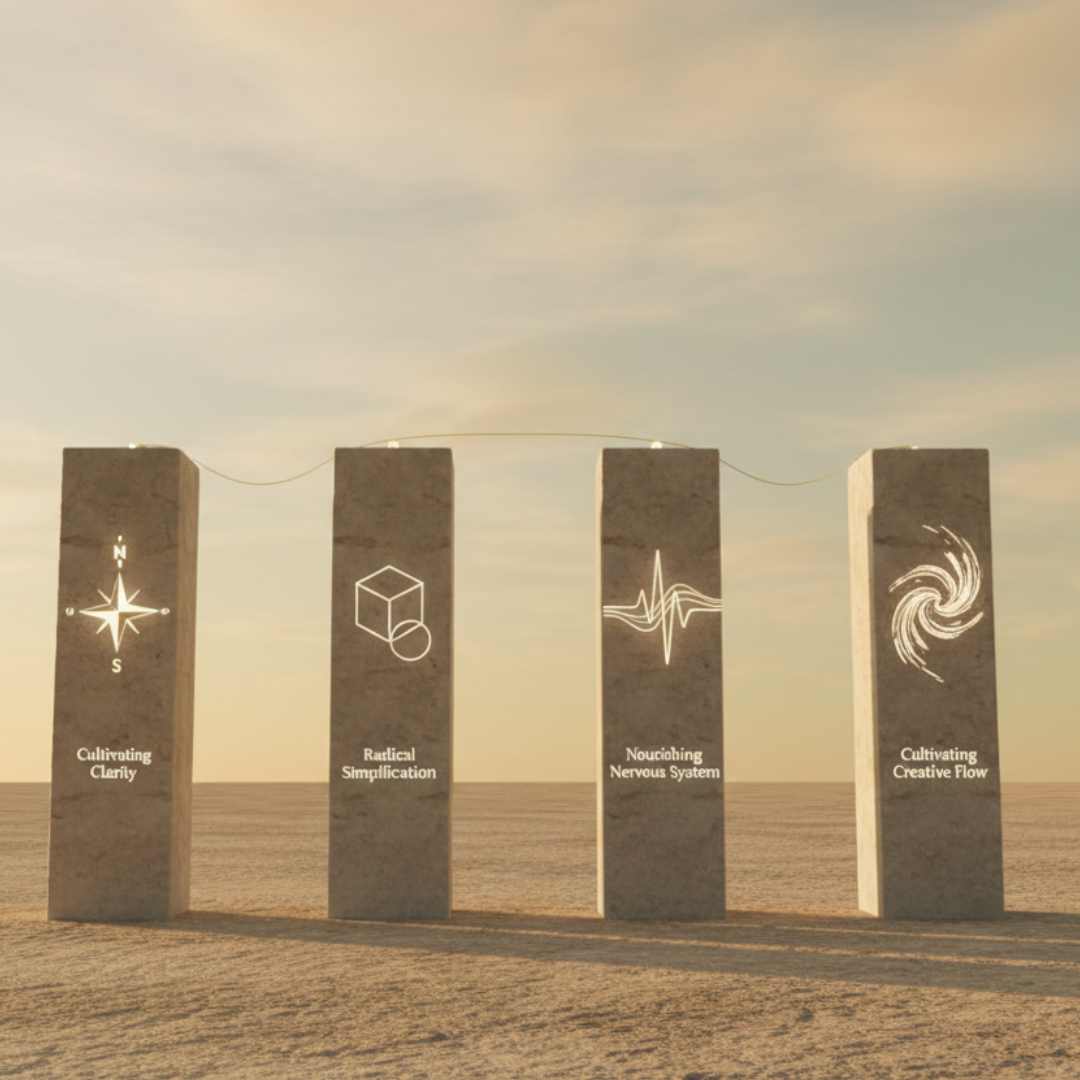
When I work with clients to build this infrastructure, I use what I call the Systems Sanctuary Framework. It has four essential pillars:
Pillar 1: Cultivating Clarity
This is about knowing your North Star, not someone else's definition of success. Before you build any system, you need to get clear on what you're actually building toward. Not what the business gurus say. Not what looks impressive on Instagram. What genuinely aligns with your vision and your actual life.
For heart-centered entrepreneurs, this often means asking different questions: What does success look like when it includes rest as a strategy? When it honors my family commitments? When it works with my energy instead of depleting it?
Pillar 2: Radical Simplification
Less is genuinely more for your nervous system. Every app you're juggling, every complicated folder structure, every task management system that requires too much mental effort—if it's not actively serving you, it's draining you.
Radical simplification asks: What can I remove? What can I consolidate? What can I make so simple that my brain doesn't have to work hard to use it?
Because complexity creates cognitive load. And cognitive load uses up the mental energy you need for your actual creative and strategic work.
Pillar 3: Nourishing Your Nervous System
Your body is your business's most vital asset. If your nervous system is constantly activated by backend chaos, you lose access to your creativity, strategic thinking, and intuition.
This pillar focuses on creating systems that feel safe to your body. Systems that communicate to your nervous system: "We've got this. You can relax. Nothing's falling through the cracks."
Pillar 4: Cultivating Creative Flow
Here's the truth: systems set you free. They don't cage you in. When your backend is handled, when your nervous system feels safe, when you have real simplification, that's when your creativity finally has room to breathe.
You're no longer spending all your energy managing chaos. You get to spend it on the work that actually matters. The meaningful work that called you into entrepreneurship in the first place.
Why This Approach Is Actually Different
Most productivity systems and goal-setting frameworks focus on doing more. Being more productive. Optimizing every minute. Hustling harder. Adding another shiny new tool or platform.
This approach focuses on creating sustainable conditions where you can do your best work without burning out.
Most systems completely ignore your nervous system. They treat you like a machine that just needs better programming or more efficient processes.
This approach recognizes you're a human being with a body that responds to stress, chaos, and overwhelm. When you create systems that honor that reality, everything changes.
Most systems give you more—more tools, more apps, more strategies that ultimately just add to your overwhelm.
This approach simplifies. Removes what's not working. Creates breathing room.
The feedback I hear consistently from clients after we build this infrastructure:
"I feel like I can finally breathe in my business."
"I'm working fewer hours and getting more meaningful work done."
"I actually have energy left at the end of the day."
"I'm excited about my business again instead of resenting it."
That's what happens when you build infrastructure instead of just setting goals you can't sustain.
Your Next Steps (And Why Timing Matters)
If this resonates, if you're exhausted from the resolution cycle, if you're ready to build real infrastructure instead of just setting goals that don't stick, if you can see how a solid backend would transform everything, then Strategic Blueprint was created specifically for you.
It's a 5-week program where we build your complete business infrastructure together. Your inbox systems. Your file organization. Your task management. Your workflows. All the backend pieces that need to be solid.
But critically, we also address the nervous system component. Because you can't build sustainable systems when your nervous system is overwhelmed. And you can't calm your nervous system when your backend chaos keeps triggering stress responses.
We address both simultaneously—the external systems and your internal state.
What you get:
- Five weeks of focused training released weekly so you're never overwhelmed
- Weekly live coaching calls for implementation support and questions
- A private one-on-one Scaled Systems Strategy Session after completing the five weeks
- Complete implementation of the 4-Pillar Framework tailored to your business
By the time Aries season arrives on March 20th (the actual energetic new year), you'll have a foundation that makes your goals inevitable instead of impossible.
Not Ready for Strategic Blueprint Yet?
I have two free resources that will help you get started:
The Aligned Action Matrix helps you identify what to prioritize first when everything feels urgent.
The Inbox Zen Guide walks you through creating a calm, intentional relationship with email instead of a reactive, stressed one.
Whether you work with me or not, I hope you truly hear this message: You're not behind. You're not failing at something everyone else has figured out. There's nothing wrong with you.
The resolution culture you've been sold is fundamentally designed to fail. But you don't have to keep playing that game.
Join the Anti-Resolution Revolution
It's February. If you don't have 2026 goals yet, good.
Because we're not setting traditional goals anymore. We're building infrastructure that supports sustainable success.
And when Aries season arrives with that fresh new-year energy, you'll have the solid foundation to make anything possible.
Here's to the anti-resolution revolution.
Stay gold, my friends.💫