The Inbox Overwhelm Spiral (And How to Break It)
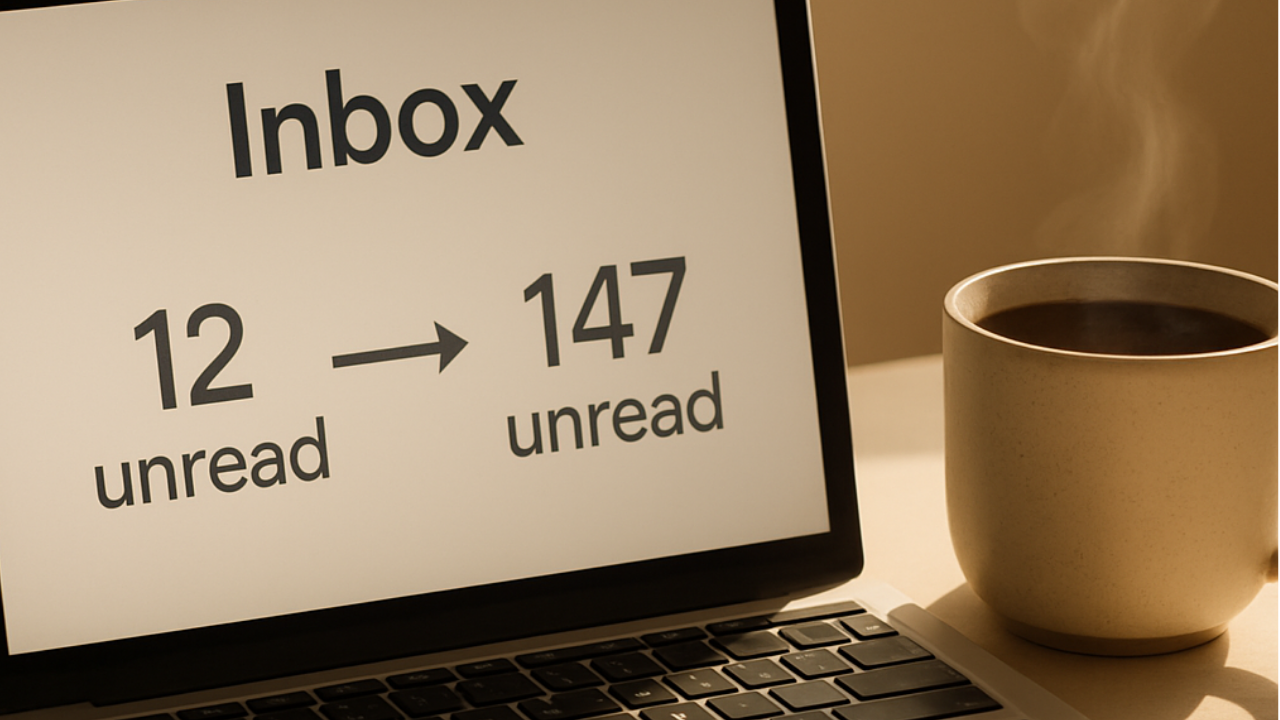
Let me guess: you woke up this morning, checked your email, and immediately felt a knot in your chest.
You scrolled through dozens (or hundreds) of unread messages. Your brain started scanning: Which one is urgent? Which one needs attention? Which one will cause a problem if you ignore it?
By the time you finally closed your inbox, you'd spent 45 minutes reacting to other people's priorities. And you hadn't done a single thing that actually moves your business forward.
Sound familiar?
This is what I call the inbox overwhelm spiral. And I see it with almost every entrepreneur I work with.
The good news? Once you understand how the spiral works, you can break it. Not with complicated systems or hours of organizing. Just a few simple shifts that change your entire relationship with email.
What the Inbox Overwhelm Spiral Actually Looks Like
Here's how it typically goes:
You open your email and see 147 unread messages. Your nervous system immediately goes into scan mode, trying to triage what feels like a crisis. Except there is no crisis. There's just... email.
But your brain doesn't know that. So you start responding.
You think you'll just handle the urgent ones. But then someone asks a question that requires research, so you switch to a different app. Then you remember you need to follow up on something from yesterday, so you search for that email. You click on three other emails along the way because they catch your attention.
Suddenly 45 minutes have passed. You've sent a few replies, opened a dozen tabs, and created more tasks than you completed.
This is the spiral. Email creates this illusion of urgency that keeps us in reaction mode all day long.
Why Email Exhausts Your Nervous System
It's not just about the time email takes. It's what email does to your body.
Every notification is a little ping telling your nervous system something needs attention. Every red badge signals something unfinished. Your system never gets to settle because there's always another email waiting.
You end the day exhausted—not because you accomplished anything meaningful, but because you've been in a constant state of low-level alert. Your body has been treating email like a series of small emergencies.
And here's what most productivity advice misses: you can't just "manage" your email better. You can't discipline your way out of this.
The problem isn't you. The problem is that email is designed to interrupt you. It's built to demand immediate attention.
So instead of fighting that design, what if you changed your relationship with email entirely?
Three Simple Shifts to Break the Spiral
You don't need a complicated system. You just need a few clear boundaries that tell your nervous system: we have a plan for this.
Shift #1: Batch Your Email
Instead of checking email constantly throughout the day, check it at specific times. Maybe three times a day—9am, noon, and 3pm. Or twice a day if that feels better.
I know that feels scary if you're used to constant checking. Your brain will try to convince you that something urgent will slip through. But here's the truth: very few things are actually urgent.
When you batch your email, your nervous system learns that there are specific times for email and the rest of the time is protected for your actual work. That shift alone creates so much calm.
Shift #2: Create a Simple Filing System
You don't need complicated categories or dozens of folders. You just need a few simple ones that help your brain stop holding everything.
I recommend three:
-
Action Needed (emails that require your response)
-
Waiting On (emails where you're waiting on someone else)
-
Reference (emails you want to keep for information)
When an email has a home, your brain can release it. You're not constantly scanning your inbox wondering what still needs attention because you've already decided.
Shift #3: Set Email Boundaries
This is the shift that changes everything: some emails don't need responses. Some can wait. And you're going to decide that, not your inbox.
Not every question requires an immediate answer. Not every request deserves space on your calendar. Not every email needs a reply at all.
You get to create the rules for your inbox. And when you do, you stop being at war with email.
Why Inbox Zen Works Better Than Inbox Zero
I don't believe in inbox zero. I follow inbox zen.
Inbox zero suggests that your inbox should be completely empty—that you need to process every single email until nothing remains. That approach keeps you chasing an impossible standard.
Inbox zen is different. It's about having a calm, intentional relationship with email. It's about knowing that your inbox doesn't control you. It's about creating systems that support your nervous system instead of activating it.
When you shift from trying to achieve zero to creating zen, everything changes. Your shoulders drop. That knot in your chest loosens. Because your nervous system finally recognizes: we have a plan. We're not under attack.
Your Next Step
If you're tired of living in reaction mode, I created something to help you.
It's called the Inbox Zen Quick Start Guide, and it's completely free. It walks you through the exact system I use with my clients to create calm in their inboxes.
You'll learn how to:
-
Set up email batching that actually works for your schedule
-
Create your simple filing system in under 10 minutes
-
Establish boundaries without guilt